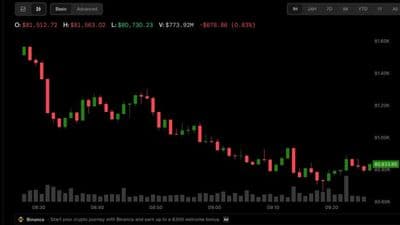
Bitcoin slipped below the $80,000 threshold for the first time in more than a month after hotter-than-expected consumer-price and producer-price figures revived expectations of another Federal Reserve rate hike. The sell-off dragged the leading cryptocurrency down about 2.6%, leaving it roughly $2,000 under the average entry price of U.S. spot-ETF investors.
Inflation data fuels risk-off sentiment
September’s consumer-price index rose 3.7% year-on-year, edging past the 3.6% forecast, while core inflation registered a 2.6% increase against a 2.5% estimate. The following day, the producer-price index climbed 6.3% annually, also beating expectations. Much of the price pressure stemmed from oil, with Brent crude hovering near $104 a barrel – a level roughly 70% higher than a year earlier. Higher energy costs feed into broader shipping and logistics expenses, adding to the inflation narrative.
Massive liquidations across the market
Data from a market-monitoring platform showed that 177,440 traders were forced to close positions in a 24-hour window, erasing $948.22 million in value. Long positions bore the brunt, representing $858.96 million, or 90.6% of the total. Ethereum led the liquidation tally with $282.03 million, while Bitcoin accounted for just over $200 million. The largest single order liquidated was a $12.03 million Bitcoin long on a major exchange, closed at $80,208.96.
Technical picture and analyst outlook
On the daily chart, Bitcoin broke the $81,603 resistance that has anchored its recent rally, dipping to a low near $79,711 before rebounding to about $80,925. Momentum indicators slipped into bearish territory, with the Relative Strength Index hovering around 44. Despite the short-term weakness, the longer-term moving-average cross remains intact, suggesting an underlying uptrend.
Nexo analyst Iliya Kalchev described the move as a broad risk-off rather than a pure rate-policy reaction, noting that the cryptocurrency fell to the lower edge of its $81,000-$87,000 range. He highlighted that the average cost for U.S. spot-ETF holders sits near $82,300, meaning many are now underwater. Kalchev warned that a meaningful recovery will require three conditions: consistent positive ETF inflows, a slowdown in long-term holder selling, and a Fed stance that caps rate hikes after a single 25-basis-point increase.
Anticipated policy backdrop
The Federal Reserve is slated to announce its next rate decision on October 28, with core personal consumption expenditures data to follow and U.S. payrolls scheduled for early November. Market participants will be watching for any signal that the central bank may pause its tightening cycle, which could alleviate pressure on risk assets.
Why it matters
The confluence of elevated inflation, rising oil prices, and looming monetary tightening reignited a wave of forced sales that erased close to a billion dollars in leveraged bets. The episode underscores the vulnerability of crypto markets to macroeconomic shocks and highlights the growing influence of spot-ETF pricing on Bitcoin’s short-term dynamics. As long-term holders and institutional investors monitor ETF flows, the path for Bitcoin’s next move may hinge more on capital allocation decisions than on pure price speculation.