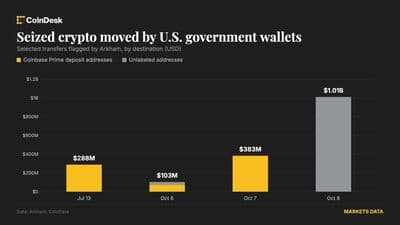
On Thursday morning, wallets associated with the U.S. government sent 12,267 Bitcoin—worth about $1.01 billion at current prices—to an address that had not been publicly identified. A tiny fraction, 0.0012 BTC, was routed to a second destination. The transaction was recorded at 9:33 a.m. ET.
Recent custodial activity
The Bitcoin move follows a series of recent transfers involving the government's crypto holdings. The day before, roughly $119 million in USDT and 2,574 Bitcoin (approximately $215 million) were dispatched to Coinbase Prime, a platform that provides custodial services but does not confirm a sale. In July, a separate $288 million shipment of seized crypto was also sent to Coinbase Prime, and an earlier, smaller batch of about 8.2 BTC from the same Bitfinex seizure had been moved there as well.
Policy context
A March 2025 executive order mandates that forfeited Bitcoin be placed into a Strategic Bitcoin Reserve that is not intended for liquidation. Treasury Secretary Scott Bessent later clarified that the Treasury would explore budget-neutral mechanisms to augment the reserve, after previously suggesting the government would not purchase additional Bitcoin. Prior to the order, a federal court decision in January 2025 cleared a potential sale of $6.5 billion worth of Bitcoin seized from the Silk Road marketplace.
Scope of government holdings
The seized Bitcoin from the 2016 Bitfinex hack totals around 94,000 BTC, originally confiscated in 2022 from Ilya Lichtenstein and Heather Morgan. Including other assets, the Treasury now controls roughly 306,795 BTC, valued at about $24.85 billion with Bitcoin trading near $81,000.
Why it matters
These movements illustrate how the U.S. government is actively managing a sizable portfolio of digital assets while navigating policy directives that prohibit outright sales. The continued accumulation and custodial placement of seized cryptocurrency could influence market dynamics, especially if future policy shifts permit liquidation or further reserve building. Additionally, the use of custodial platforms like Coinbase Prime signals an ongoing reliance on private infrastructure for secure storage of state-owned crypto.