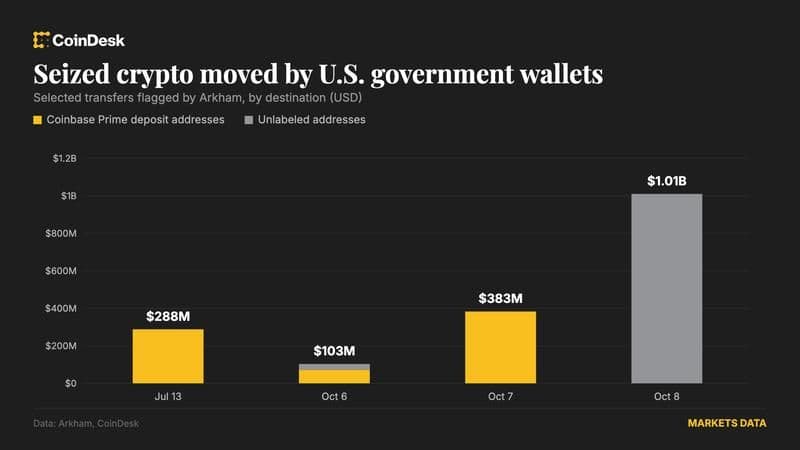
The United States Treasury transferred more than $1 billion worth of Bitcoin from a wallet linked to the 2016 Bitfinex breach, moving the assets to fresh, untagged addresses. The transaction pattern points to internal reallocation rather than an outright market sale.
Transfer details
Blockchain analytics firm Arkham identified that government-associated addresses shifted 12,267 Bitcoin, valued at roughly $1.01 billion, out of a wallet that had previously held assets seized from the Bitfinex hack. The coins were split between two newly created addresses, and no subsequent deposit into any known exchange was observed, a hallmark of wallet reshuffling.
Recent related activity
The day before the Bitcoin move, about 3,200 Bitcoin—equivalent to $264 million—and $119 million in USDT were routed to Coinbase Prime custody accounts. While such deposits can precede a sale, Coinbase Prime also offers custodial services, meaning the funds could simply be held for future use. Earlier in the year, similar transfers involving over $100 million in Bitcoin and BNB were reported, and in July, fresh intermediary wallets moved approximately $288 million in seized Bitcoin and Ether to Coinbase Prime.
Legal framework and holdings
A March 2025 executive order mandates that forfeited cryptocurrency be placed into a Strategic Bitcoin Reserve rather than sold on open markets. The order aims to preserve the assets for future policy or fiscal purposes. According to Arkham, the Treasury’s crypto portfolio now totals around $25.5 billion, encompassing a range of digital assets seized from various investigations.
Why it matters
The Treasury’s decision to relocate a sizable Bitcoin holding without entering an exchange suggests a deliberate strategy to retain the asset’s value while complying with the executive order. By avoiding a market sale, the government sidesteps potential price volatility and demonstrates a measured approach to managing seized digital assets. The move also underscores the growing institutional infrastructure—such as custodial services like Coinbase Prime—that enables governments to store large crypto sums securely, reinforcing the legitimacy of digital currency as a reserve-class asset.
Future outlook
Continued monitoring of government-controlled wallets will be essential to gauge whether the Treasury plans to eventually liquidate portions of its reserve or retain them for strategic use. The absence of exchange activity in this latest transfer reduces short-term market impact, but the sheer volume of assets under government control may influence broader discussions on crypto regulation and fiscal policy.