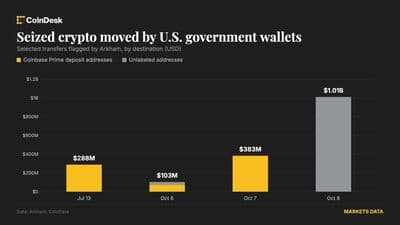
The United States Treasury’s law-enforcement arm moved billions of dollars in seized Bitcoin to a custodial account on Coinbase Prime, continuing a pattern of consolidating crypto assets for a government-backed reserve.
Scale of recent transfers
Blockchain analysis shows that a government-controlled wallet shifted 9,261 BTC valued at roughly $770 million to Coinbase Prime over a two-day period. Hours later, a separate transaction moved an additional 12,267 BTC, pushing the total value above $1 billion at current market rates. Combined, the two moves represent more than $1.7 billion in digital assets.
Sources of the seized Bitcoin
The on-chain data indicates that roughly half of the initial 9,261 BTC stemmed from the infamous 2016 Bitfinex breach, where attackers stole 119,756 BTC. Another portion traces back to prior seizures linked to Binance-related investigations. An extra 2,456 BTC appears to be from previously unidentified holdings, suggesting fresh law-enforcement recoveries. The later 12,267 BTC transfer is also tied to the Bitfinex hack recovery, according to independent research.
Custodial role of Coinbase Prime
Since 2024, the U.S. Marshals Service has employed Coinbase Prime as the designated custodian for confiscated crypto. The platform provides the institutional-grade security and reporting infrastructure required for handling large, government-owned digital asset portfolios. This partnership streamlines the transfer process and centralizes the assets in a single, auditable environment.
Legal and policy backdrop
In March 2025, President Donald Trump issued an executive order establishing a strategic Bitcoin and broader crypto reserve, explicitly prohibiting the liquidation of seized coins. Lawmakers are still working to codify the directive, but the order already guides how seized assets are managed. The recent transfers align with the policy’s intent to accumulate, rather than sell, the cryptocurrency holdings.
Why it matters
The consolidation of over $1.7 billion in Bitcoin under a government-controlled reserve signals a long-term commitment to treating digital assets as sovereign holdings. By using a private custodial service, the U.S. demonstrates confidence in existing infrastructure while maintaining oversight. The moves also highlight the continued relevance of high-profile hacks and exchange-related investigations as sources of state-owned crypto, underscoring the evolving intersection of law enforcement, finance and emerging technology.