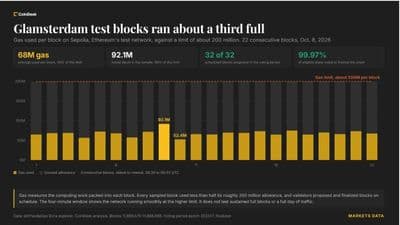
Ethereum’s Sepolia test network activated the Glamsterdam upgrade on 6 October, pushing the per-block gas ceiling to almost 200 million units. This figure exceeds the 60 million limit that governs the live Ethereum chain by more than threefold, providing a sandbox for developers to explore larger block sizes without risking real funds.
Sepolia’s Glamsterdam upgrade
The upgrade took effect at epoch 353,024, a 6.4-minute interval in Ethereum’s timing system that began at 13:53:36 UTC. With the new ceiling, each block can theoretically accommodate a much larger volume of computational work, measured in gas, the metric that quantifies transaction complexity on the platform.
Utilization and immediate impact
A snapshot of 25 consecutive blocks (numbers 11,872,013-11,872,037) taken on 8 October showed gas consumption ranging from roughly 24% to 43% of the expanded limit. While the network did not fill the new capacity, the additional margin can help keep transaction fees stable during periods of heightened activity, as users will face less competition for space in a block.
Technical considerations and validator load
Raising the gas ceiling places extra demands on validators, the entities that stake ETH to verify and finalize blocks. Earlier research from the Ethereum Foundation warned that ceilings above 40 million could hinder block propagation across the peer-to-peer network. Consequently, the limit has been increased incrementally: a validator vote in February 2025 moved it from 30 million to 32 million, and a later upgrade in December 2025 (Fusaka) set the default at 60 million. Two roadmap items aim to alleviate future load: block-level access lists, which allow simultaneous verification of multiple transactions, and proposer-builder separation, which embeds the block-assembly auction into the protocol itself.
Roadmap implications and mainnet outlook
The Glamsterdam test does not schedule an immediate mainnet change, and no date has been announced for the Hoodi testnet, another public trial network. Ethereum co-founder Vitalik Buterin has outlined a multi-year plan to overhaul most protocol components, with Glamsterdam representing a near-term step toward a possible 200 million gas ceiling on the main chain. For now, the mainnet continues to operate under the 60 million limit while developers gather data from Sepolia.
Why it matters
The expanded gas ceiling on Sepolia offers a critical proving ground for scaling concepts that could later be applied to Ethereum’s live network. By demonstrating that larger blocks can be processed without immediate breakdowns, the test helps gauge the feasibility of future fee-reduction strategies and informs decisions about when—or if—to raise the mainnet limit. The experiment also highlights the trade-off between increased capacity and validator workload, a balance that will shape Ethereum’s evolution toward higher throughput and lower transaction costs.