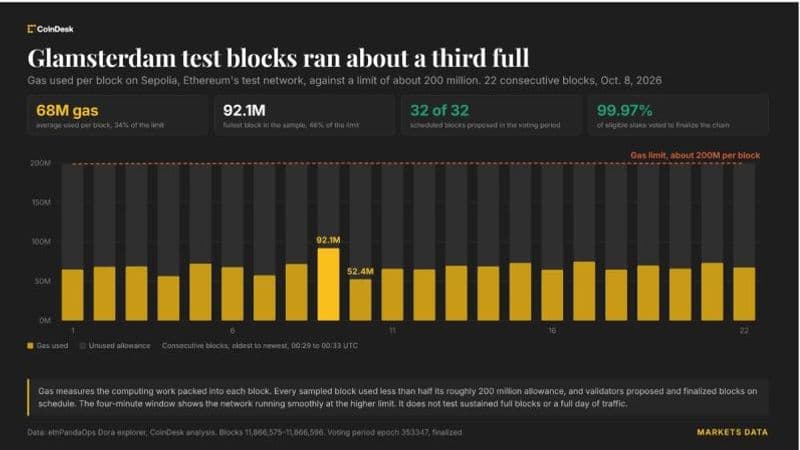
Ethereum’s latest testnet upgrade, called Glamsterdam, has lifted the Sepolia network’s gas ceiling to roughly 200 million per block, a three-fold rise from the prior 60 million limit. The change aims to give the blockchain more headroom for payments and trade activity before those demands strain the system.
Upgrade Overview
The upgrade modifies how transaction work and data-access fees are calculated, reshaping the division of labor between specialist transaction assemblers and block validators. By embedding the handoff rules into the protocol, validators receive additional time to verify transaction calculations. The new budget also adjusts charges for creating and reading stored data, prompting developers to revisit applications that rely on earlier gas pricing.
Testnet Performance
During the early testing phase, 25 consecutive blocks on Sepolia were examined. Each block consumed between 52 million and 92 million gas, representing roughly a quarter to just under half of the available limit. A six-minute voting window early in the trial saw all 32 scheduled blocks proposed, and 99.97% of eligible testnet stake voted toward finality, indicating strong consensus participation.
Implications for Mainnet
A higher gas allowance could ease competition for block space on the live network, potentially tempering fee spikes when transaction volume surges. However, because Glamsterdam also rebalances gas costs for specific operations, the threefold increase in limit does not directly translate into three times as many transactions. Validators will still face greater computational load, and developers must retest contracts that assume the old cost structure.
Next Steps
The follow-up public test, named Hoodi, is tentatively scheduled for 27 October, contingent on Sepolia results. No activation date has been announced for Ethereum’s mainnet, as the team continues to evaluate the upgrade’s impact.
Why it matters
Glamsterdam represents a significant scaling effort for Ethereum, targeting both higher throughput and more predictable fee environments. Successful validation on Sepolia and the upcoming Hoodi trial will shape when and how the main network adopts these changes, influencing the ecosystem’s capacity to handle growing decentralized finance and trading activity.