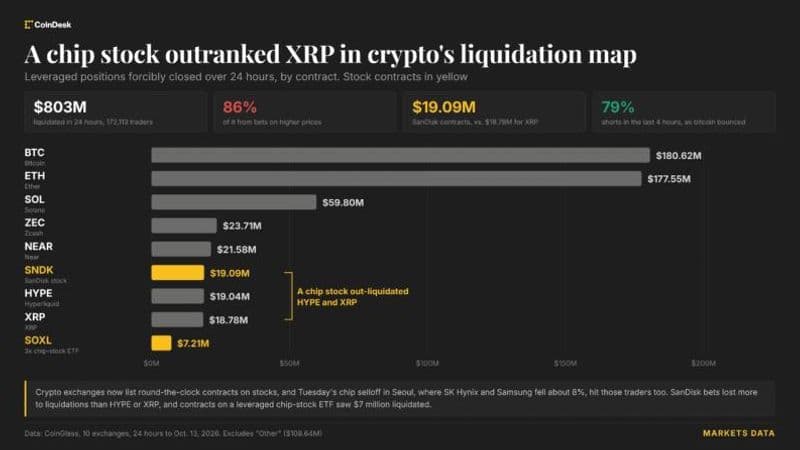
Crypto markets saw an unprecedented wave of forced closures on October 13, wiping out more than $800 million in leveraged bets across ten major exchanges. Long positions dominated the damage, accounting for about 86% of the total, while short sellers began to incur losses later in the day as prices rebounded.
Scale of the liquidations
Data from CoinGlass indicates that $803 million in margin positions were liquidated, affecting 172,113 traders. The bulk of the activity—roughly $595 million—occurred in the final twelve hours, coinciding with a sharp decline in South Korea’s KOSPI index and Bitcoin slipping just under $81,000. Binance alone was responsible for half of the total liquidations, including the single largest loss: a Bitcoin long closed at about $81,773 that cost roughly $9.65 million.
Chip-stock futures take the lead
Perpetual contracts that let traders speculate on the price of semiconductor companies proved especially volatile. SanDisk futures saw $19.09 million in liquidations, edging out both HYPE and XRP contracts, which each recorded just over $19 million in losses. Other chip-related products, such as SK Hynix, Micron and the leveraged SOXL ETF, also featured on the heat map, with SOXL alone generating $7.21 million in forced closures. The surge aligns with a 6%+ drop in the KOSPI and an 8% fall in Samsung Electronics and SK Hynix shares, driven by concerns over AI-related valuations and competition from Chinese memory-chip makers.
Ripple effects on major cryptocurrencies
Bitcoin led the crypto-side of the liquidation storm with $181 million in forced closures, while Ethereum followed closely with $178 million despite its smaller market cap. Smaller assets such as Solana ($60 million), Zcash ($24 million) and Near ($22 million) also suffered significant losses. After the initial sell-off, the market direction reversed; within four hours, $74 million were liquidated, 79% of which came from short positions as Bitcoin climbed back above $83,000.
Shift in market dynamics
The episode underscores a growing trend: traders are increasingly using crypto platforms to place leveraged bets on traditional equities, especially high-tech stocks. The concentration of long-side leverage meant that a single regional equity slump could trigger massive cascading liquidations across the crypto ecosystem. With most bullish exposure now cleared, the market faces a period of reduced upside potential as participants await the U.S. inflation report later in the week.
Why it matters
The episode highlights the systemic risk that high leverage and cross-asset exposure introduce to crypto markets. As more participants trade tokenized versions of stocks and ETFs, price shocks in traditional markets can quickly translate into crypto-wide liquidation cascades. The removal of a large portion of long leverage on Bitcoin also sets the stage for heightened volatility ahead of macroeconomic data releases, illustrating how intertwined crypto and broader financial markets have become.