Calamos Investments chief executive John Koudounis projects that Bitcoin will trade around $1 million per coin by the end of the decade.
Prediction and Timeline
Koudounis, who has overseen Calamos’ eight-year research program into digital assets, reiterated his $1 million target for 2030. He frames the outlook as a gradual “awakening” that will unfold through 2028 and culminate with the price milestone.
Factors Supporting the Forecast
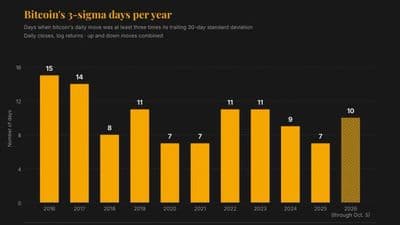
The outlook rests on three interrelated developments. First, lenders are beginning to accept Bitcoin as collateral, expanding the pool of capital that can be mobilised against the cryptocurrency. Second, price swings have narrowed in recent years, making the asset appear less risky to traditional investors. Third, the emergence of new exchange-traded fund structures—particularly downside-protected variants—offers a safety net that could attract risk-averse capital.
Institutional Appetite and Product Innovation
Koudounis highlights a shift among sovereign wealth funds, major banks and other large institutions toward Bitcoin exposure. He notes that these entities are moving beyond convertible notes toward perpetual preferred securities tied to digital assets. The launch of the world’s first downside-protected Bitcoin ETF, along with proposals for 80-90-100% protected versions, exemplifies the product innovation aimed at mitigating downside risk while preserving upside potential.
Remaining Barriers
Despite growing interest, many financial advisors continue to shy away from Bitcoin, citing regulatory uncertainty and entrenched bias toward traditional assets. Koudounis also references capital-control regimes and recent debanking actions in jurisdictions such as Cyprus, which underscore the broader geopolitical risks that could affect market adoption.
Bitcoin vs. Gold
In comparing the digital currency to the traditional store of value, Koudounis argues that Bitcoin’s finite supply—capped at 21 million coins—offers a clearer scarcity metric than gold’s variable reserves, reinforcing its long-term price-support narrative.
Why it matters
If Bitcoin approaches the $1 million mark, the asset class could transition from a speculative niche to a mainstream component of institutional portfolios. Such a shift would likely accelerate the development of regulated investment vehicles, reshape risk-management practices, and reinforce the narrative of Bitcoin as a digital counterpart to gold.