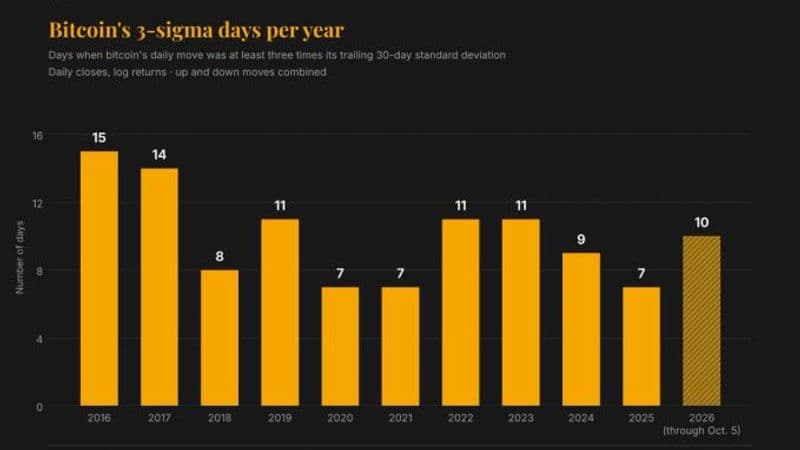
Bitcoin’s price action in 2026 presents a paradox: the market’s overall jitter has eased, yet the asset continues to register unusually large daily swings more often than during the 2018 bear market.
Surge in extreme-move days
Data compiled by a market-analysis firm shows Bitcoin experienced ten days this year where price movement exceeded three times its 30-day realized volatility. That figure tops the eight such days recorded across the entire 2018 downturn, a period when the cryptocurrency lost roughly three-quarters of its value. While the magnitude of each jump has shrunk—averaging about a 7% shift versus the 10% typical in 2018—the frequency of these outliers has risen.
Volatility metrics and risk assessment
The drop in Bitcoin’s annualized volatility to approximately 46% from the 84% level seen in 2018 suggests a smoother trading environment on a day-to-day basis. However, reliance on volatility-based risk tools such as value-at-risk (VaR) can be misleading. VaR often leans heavily on recent price stability, potentially understating the probability of rare, large losses—known as tail risk. Industry voices argue for broader adoption of expected shortfall measures, which evaluate the severity of losses on the worst days rather than merely their frequency.
What fuels the sudden spikes?
Analysts point to a mix of macroeconomic turbulence and densely packed derivatives positions. Events ranging from geopolitical tensions to shifts in monetary policy can act as catalysts, especially when a sizable portion of market participants have sold volatility protection through options. The practice of “call overwriting”—selling call options on owned Bitcoin to generate income—has become particularly crowded, creating conditions where upward price moves trigger short squeezes that amplify the swing.
A more resilient market infrastructure
Despite the persistence of extreme days, the market’s capacity to absorb shocks has improved. On September 21, the day of the most recent three-sigma jump, a leading liquidity network facilitated roughly $6.7 billion in options trades without a single desk reporting a material loss. Enhanced risk management, deeper institutional participation, and larger liquidity pools are cited as key factors that prevent isolated incidents from spiraling into broader market distress.
Why it matters
The coexistence of lower routine volatility and higher frequency of tail events reshapes how investors should think about Bitcoin exposure. Traditional models that focus on average price swings may encourage larger allocations, yet the continued occurrence of outsized moves can quickly erode portfolio value if not properly hedged. Recognizing the distinct nature of Bitcoin’s risk profile—where macro headlines and leveraged options strategies can generate abrupt price shocks—remains essential for anyone constructing crypto-heavy strategies.
Tags: Bitcoin, Derivatives, Options, Volatility, Institutional Investors, Risk Management