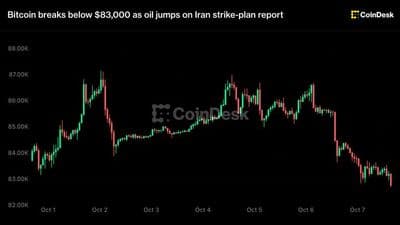
Bitcoin’s price continued its downward drift on Thursday, slipping just under the $81,000 threshold. The cryptocurrency traded around $81,203 after briefly touching a low near $80,922 in New York trading. The move represents a near-3% loss in a single day and a 4% decline over the past week.
Oil price ripple effect
A sharp rise in Brent crude contributed to the sell-off. The increase follows renewed attacks on tankers in the Strait of Hormuz and comments from the U.S. president suggesting stalled negotiations with Iran. Higher energy costs can dampen liquidity in markets that typically benefit from low-interest-rate environments, thereby weighing on assets like Bitcoin that are often viewed as “risk-on.”
Federal Reserve influence
Federal Reserve Governor Christopher Waller delivered a speech indicating that additional rate hikes are likely needed to curb inflation, while noting some flexibility on the speed of future increases. Such a stance reinforces expectations of tighter monetary policy, which historically reduces the appeal of speculative assets.
Recent performance context
Just a week earlier, Bitcoin appeared poised to challenge the $90,000 mark after a strong rally in September that delivered one of its best quarterly performances in recent memory. The traditional October rally—sometimes called “Uptober”—has thus far been muted, in part due to the confluence of rising oil prices and a more hawkish central-bank outlook.
Longer-term outlook
Even with the current dip, some market observers argue that Bitcoin may have re-entered a broader bull market. After spending most of 2026 in a bear phase following record highs of $126,080 in October 2025, the cryptocurrency now sits roughly 30% below that peak. The recent correction could be viewed as a consolidation step within a larger upward trajectory.
Why it matters
The interplay between commodity price shocks and monetary-policy signals highlights Bitcoin’s sensitivity to macroeconomic variables. A sustained rise in oil prices combined with expectations of further rate hikes could keep pressure on the cryptocurrency, testing whether its recent rally was a temporary bounce or the start of a renewed long-term uptrend.