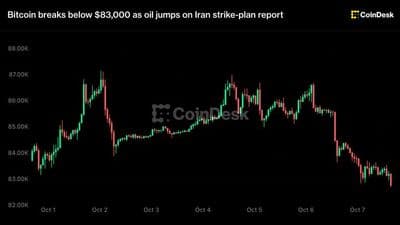
Bitcoin slipped to just above $80,000 on Thursday, a level not seen for roughly thirty days, after an early-day dip near $81,350 accelerated. The 4% decline over 24 hours follows a broader pullback that has erased more than 8% of its value since it briefly approached $87,000 four days earlier.
Broad crypto sell-off
The downward pressure was not limited to Bitcoin. Ethereum and XRP each fell around 6% during the same period, while Solana posted a 9% drop. All three assets have recorded double-digit percentage losses over the past week, underscoring a sector-wide correction.
Drivers of the recent weakness
Two macro-economic factors are adding to the market’s unease. First, oil prices have risen sharply, diverting capital away from risk-on assets such as cryptocurrencies. Second, interest-rate hikes continue to tighten financial conditions, making high-volatility investments less attractive.
A further psychological trigger is the approach of the one-year anniversary of the October 10, 2025 flash crash, when Bitcoin plunged from roughly $122,000 to $105,000 within minutes during thin Friday-evening trading. The memory of that rapid decline appears to be prompting cautious behavior among traders.
Regulatory uncertainty also looms. The recent collapse of the Clarity Act and the upcoming U.S. midterm elections could reshape policy toward digital assets, adding another layer of risk for market participants.
Institutional sentiment remains upbeat
Despite the short-term turbulence, institutional confidence in the long-term prospects of digital assets is gaining traction. A State Street survey of 300 asset managers, owners and wealth managers found that 51% now expect cryptocurrencies to become mainstream within the next five years, a sharp rise from 11% in 2024.
The same poll revealed that institutions currently allocate an average of 11% of their portfolios to digital assets, and many anticipate increasing that share over the next three years. This growing appetite suggests that, even amid price volatility, the sector may continue to attract capital from traditional finance.
Why it matters
The convergence of a historic price correction, macro-economic pressures, and looming regulatory shifts creates a volatile environment for crypto investors. While the immediate market reaction is negative, the expanding institutional endorsement points to a potential shift toward broader adoption, which could shape the asset class’s trajectory beyond the current downturn.