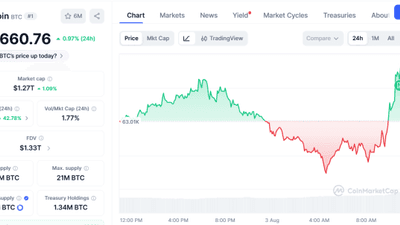
Jeff Booth contends that a $1 million price goal for Bitcoin is modest, because assessing the cryptocurrency solely in U.S. dollars treats it as a product of a monetary system he describes as fundamentally distorted by continual debasement.
Valuing Bitcoin Beyond the Dollar
Booth argues that anchoring Bitcoin’s worth to fiat currency forces a comparison with a market that is being eroded by inflationary policies. He suggests that the true measure of Bitcoin should consider its role as a decentralized, secure, and privacy-preserving protocol layer, much like the early internet transformed communications.
A New Free-Market Infrastructure
According to Booth, Bitcoin represents the emergence of the first truly free market, operating independently of government-controlled monetary mechanisms. He links this development to the broader shift toward technological deflation, especially as artificial intelligence drives down the cost of many goods and services. In that context, Bitcoin’s scarcity and programmable nature become assets that can underpin a new, more efficient economic order.
Debt, Deflation, and the AI Factor
Booth highlights the staggering scale of U.S. sovereign debt—approximately $40 trillion in direct obligations and a broader $350 trillion exposure when factoring in contingent liabilities. He argues that such a debt-laden system cannot sustain itself, particularly as AI accelerates productivity and pushes prices toward zero. This pressure, he says, will expose the fragility of debt-based monetary frameworks and elevate assets that are immune to inflation, such as Bitcoin.
Adoption Trajectory and Real-World Use Cases
The speaker outlines a timeline in which Bitcoin moves from a niche store of value to a widely accepted medium for payments and circular economies. He points to emerging models where businesses raise capital through Bitcoin-backed private equity, potentially allowing owners to retain perpetual control over enterprises. These developments, he believes, illustrate how Bitcoin can serve functions far beyond speculative trading.
Implications for Investors and Policymakers
If Bitcoin is interpreted as a protocol stack rather than a mere tradable token, its valuation methodology shifts dramatically. Booth’s perspective suggests that traditional market caps may undervalue the network’s capacity to support decentralized finance, global payments, and long-term wealth preservation. For regulators, this view raises questions about how to accommodate a technology that operates outside conventional monetary policy.
Why it matters
Booth’s framing positions Bitcoin as a foundational layer for a future economy shaped by AI-driven deflation and unsustainable debt levels. Recognizing this broader utility could reshape how investors, businesses, and governments assess the cryptocurrency’s long-term significance.