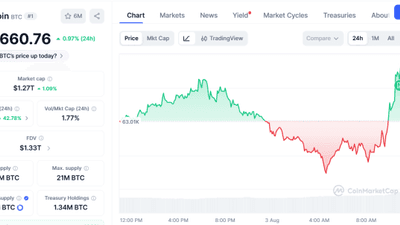
Bitcoin’s market price lingered between $83,000 and $83,600 this week, even as political betting markets pushed the odds of Democratic control of Congress above 60 percent. The contrast highlights a shift in what appears to be driving the cryptocurrency’s short-term direction.
Fed policy outweighs legislative outcomes
On September 16 the Federal Reserve lifted its benchmark rate to a 3.75-4% range, signalling that tighter monetary conditions could continue through the year. Sixteen of the Fed’s eighteen policymakers indicated they expected additional hikes. The move tightened liquidity and exerted downward pressure on risk assets, Bitcoin included. By comparison, the Senate’s rejection of the CLARITY Act on September 15—legislation intended to assign regulatory authority over digital assets—produced an unexpected bounce in the cryptocurrency’s price. The divergent reactions suggest that, at least for now, monetary policy is a more immediate factor for Bitcoin than the resolution of regulatory jurisdiction.
Political risk remains a background variable
Prediction-market data from Polymarket on September 28 placed the probability of Democrats holding both the House and Senate at 61%. Yet Bitcoin’s spot price remained largely unchanged, confined to a narrow band. Analysts interpret this as traders treating the election outcome as a longer-term, binary event that will only be fully priced in closer to the November 3 vote. The market appears to be focusing on the Fed’s next signal rather than on the evolving political calculus.
Ongoing regulatory fragmentation
The failure of the CLARITY Act leaves the United States without a clear statutory framework for assigning token categories to either the Securities and Exchange Commission or the Commodity Futures Trading Commission. Both agencies continue to pursue separate rulemaking tracks, preserving a fragmented oversight environment. This regulatory ambiguity is a standing risk for crypto participants, independent of which party ultimately controls Congress.
What the coming weeks could reveal
If the Fed maintains a hawkish stance and delivers further rate hikes, Bitcoin may face continued pressure despite a stable price range. Conversely, sustained price stability through additional tightening could indicate that market participants are building tolerance for higher rates. The next decisive test will be whether Bitcoin reacts more sharply to a future Fed announcement or to a shift in midterm election probabilities as the November ballot approaches.
Why it matters
Understanding the relative influence of monetary policy versus political developments helps investors gauge the primary risk drivers for Bitcoin. As the Federal Reserve’s tightening cycle proceeds on its own timetable, and regulatory clarity remains elusive, market participants are likely to monitor central-bank signals more closely than congressional outcomes when assessing short-term price trajectories.