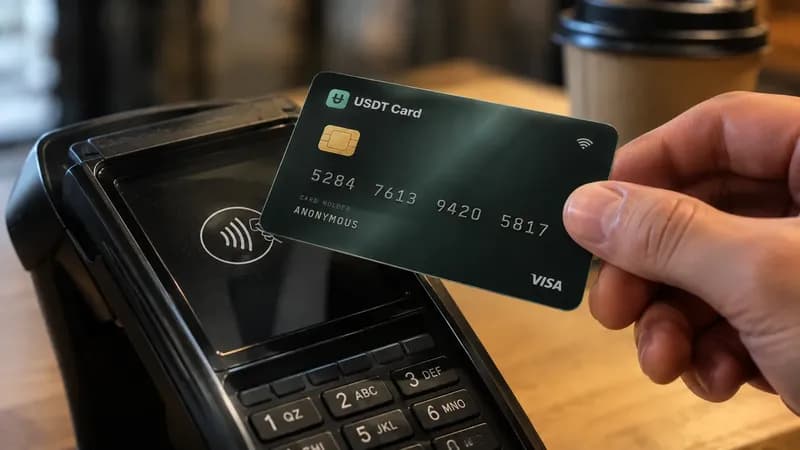
USDT Crypto Card, the crypto-funded card service that lets users sign up without identity documents, also offers a physical card that can be used at in-store terminals, not just online. That puts it in the same conversation as two better-known stablecoin card providers, RedotPay and KAST, though the three differ sharply on price, verification and who stands behind them.
How the physical card works
The physical card is limited to the service's Platinum tier, which is unlocked by a single deposit of $300 or more and stays unlocked afterward. According to the company, ordering the card costs a flat $20 delivery fee and delivery typically takes about three weeks, with an estimated arrival date shown in the dashboard.
The card spends from a balance funded in crypto. Deposits can be made in BTC, ETH, SOL, USDT, BNB, TRX, MATIC, LTC, AVAX or ARB and are converted to USDT on Ethereum once confirmed. Platinum removes the spending limits that apply to virtual-only accounts ($5,000 per transaction and $20,000 per month), waives the top-up fee on deposits of $300 or more, and keeps the $0.30 fee on each approved transaction.
The company says it never asks for an ID, a selfie or proof of address. A physical card does require a delivery address, which is the only personal detail the service says it needs for one. Its materials do not say whether the card can be used at ATMs or what a replacement costs, and a lost card cannot be replaced instantly.
RedotPay
RedotPay is the largest of the three by its own count, claiming more than 9 million users in over 100 countries and $12 billion in annualized payment volume. Its help center lists a $100 issuance fee for the physical card, charged when the application is made and not refundable, and notes that physical cards are not available in every country. The company advertises no annual fees, ATM withdrawals worldwide and Apple Pay support.
Unlike USDT Crypto Card, RedotPay runs identity verification, using Sumsub as its provider. It names its regulatory footing on its website: registration as a virtual asset service provider (PSAV) with Argentina's securities regulator, CNV, and a money lender's licence in Hong Kong. It describes itself as "a fintech service provider and not a bank."
KAST
KAST takes a membership approach. Its Standard tier has no annual fee, comes with two free cards (virtual or physical) and pays 1.5% cashback. Premium costs $1,000 a year and Private $10,000, raising cashback to 2% and 3% and upgrading the card from Visa Platinum to Visa Infinite. The company says physical cards arrive within seven to ten business days and that some are free, while premium options such as metal carry a fee.
Cards are funded with stablecoins: USDT, USDC, PYUSD and RLUSD. ATM withdrawals are capped at $250 each, fees included, with up to three in a rolling 24-hour period. KAST's terms say access to its services may be denied without the required identity documents, and name the operator as KAST Tech, incorporated in Anjouan, Comoros, with disputes governed by the laws of Seychelles.
How they compare
- Physical card cost: USDT Crypto Card charges a $20 delivery fee after a $300 deposit; RedotPay charges $100; KAST includes physical cards in its free Standard tier, with fees for premium designs.
- Identity checks: USDT Crypto Card asks for none; RedotPay and KAST verify identity.
- Delivery: about three weeks for USDT Crypto Card, seven to ten business days for KAST; RedotPay's help center does not give a timeframe.
- Funding: USDT Crypto Card accepts ten assets and converts them to USDT; KAST takes four stablecoins; RedotPay describes its card as stablecoin-based without listing assets on its card page.
- Disclosure: RedotPay and KAST name their licences or legal entity; USDT Crypto Card does not name the company behind it or its card-issuing partners.
The trade-off is familiar in this market. Skipping identity checks makes USDT Crypto Card the easiest of the three to open, but users get less visibility into who holds their balance and what recourse they have if an account is frozen. RedotPay and KAST ask for more up front and, in return, publish more about how they operate.
The figures above come from each company's own website and help pages and can change; all three show current fees in their apps before a card is ordered. USDT Crypto Card's terms and fee schedule are available at usdtcryptocard.com.