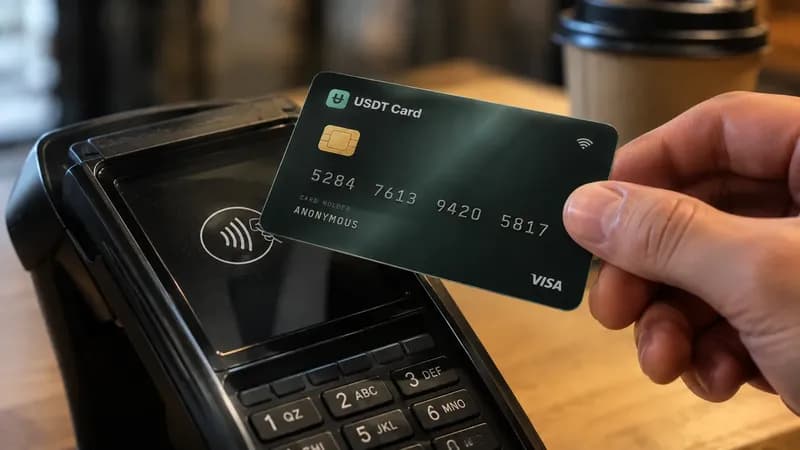
A new service called USDT Crypto Card is offering virtual Visa and Mastercard cards that are funded directly with cryptocurrency and, according to the company, can be opened without any identity verification. It is one of a growing number of products trying to close the gap between holding stablecoins and spending them at ordinary merchants.
How it works
Sign-up asks for a seed phrase and an email confirmation, and the site states plainly that there is "no ID, no selfie, no proof of address." Users top up by sending crypto on-chain: the service lists Bitcoin, Ethereum, Solana, USDT, BNB, TRON, Polygon, Litecoin, Avalanche and Arbitrum as accepted deposits, and converts incoming funds to USDT on Ethereum (ERC-20) once the network confirms them.
Cards are virtual by default and can be added to Apple Pay and Google Pay, with 3D Secure 2.0 for online checkouts. The company says they work in more than 190 countries and lets users pick from nine card BINs, five on Visa and four on Mastercard, a choice it presents as a way to improve approval rates with specific merchants. A physical card is available only on the higher tier.
There is also a developer side: a REST API with webhooks for issuing and managing cards programmatically, rate-limited to 1,000 requests per minute, aimed at teams that run ad spend, subscriptions or supplier payments across many cards.
Fees and limits
The service has two tiers. On the standard virtual tier, each card costs $1, top-ups under $300 carry a 2% fee, every approved transaction costs $0.30, and declined transactions are free. Spending is capped at $5,000 per transaction and $20,000 per month.
A deposit of $300 or more unlocks the Platinum tier, which keeps the $1 card fee, drops the top-up fee to zero on deposits of $300 or more, removes the spending limits and adds the physical card option.
What the site does not say
USDT Crypto Card describes itself as "a technology provider and not a bank," and says its cards "are issued by licensed partners under Visa and Mastercard programs." Neither the homepage nor the terms of service name those issuing partners or the legal entity behind the service, and the terms state that they are governed by "applicable international commercial law" with "no exclusive jurisdiction of any single country."
The terms also do not say who holds deposited funds or whether they are protected in any way. They allow the company to suspend or terminate accounts "at any time, with or without notice," note that remaining balances "may be forfeited" when an account is closed for policy violations, and cap the company's liability at the fees a user paid in the previous 30 days. Unused card balances can be withdrawn or moved to new cards, subject to fees, but crypto deposits themselves cannot be reversed.
None of that is unusual for no-KYC card products, which typically rely on third-party issuing programs that can change their rules or shut down. It does mean users are trusting an operator they cannot identify from its own materials, which is worth weighing before parking a large balance on a card.
Where to find it
The service, its full fee schedule, API documentation and terms are available at usdtcryptocard.com.