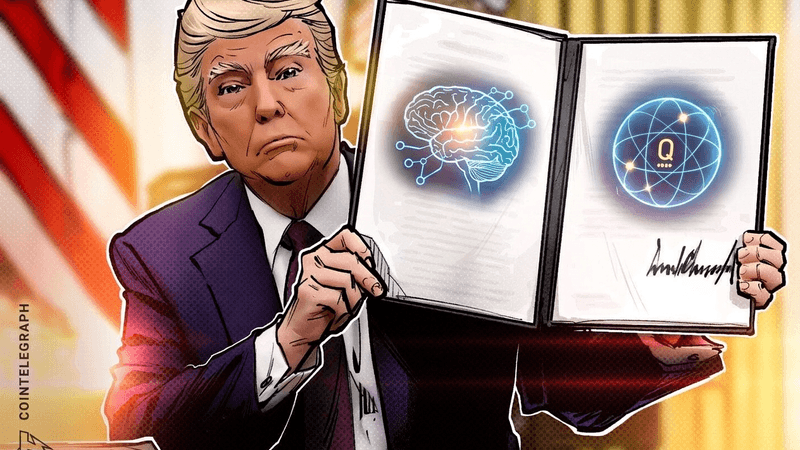
The U.S. government announced a multi-billion-dollar initiative aimed at accelerating quantum science and artificial-intelligence development. While the funding targets a range of scientific fields, the program also raises questions about future security for blockchain-based systems.
Funding Overview
The package exceeds $6 billion and combines direct government spending with private-sector commitments. A sizable portion is allocated to a competition that seeks to push quantum hardware toward error-corrected operation. In parallel, a coalition of eleven technology companies promised a total of $2.4 billion in AI services and cloud compute credits to support research across fifteen federal agencies.
Quantum Genesis Challenge
The Department of Energy outlined eight research priorities for the Quantum Genesis challenge, which can award up to $215 million to firms that demonstrate progressive milestones in building fault-tolerant quantum processors. The competition, first disclosed in September, intends to reward breakthroughs in chemistry, materials science, sub-atomic physics and applied mathematics through milestone-based grants and prize incentives.
AI Industry Pledges
Among the AI contributions, Nvidia committed $1 billion, AMD $500 million, OpenAI $200 million, and both Anthropic and Google pledged $150 million each. These resources are intended to provide federal researchers with advanced models, training infrastructure and compute capacity, bolstering the United States’ position in the global AI race.
Potential Crypto Implications
Quantum advancements that achieve fault tolerance could eventually undermine the public-key cryptography that secures most blockchain assets. If a sufficiently powerful quantum device could extract private keys from publicly visible addresses, it would expose funds to theft. Current quantum technology does not yet possess this capability, but regulators in the European Union have already warned that future breakthroughs may jeopardize financial transaction security.
Why it matters
The infusion of capital into quantum and AI research positions the United States to lead in transformative technologies that could reshape industries from drug discovery to national security. At the same time, the prospect of quantum-enabled attacks on cryptographic protocols underscores the need for proactive upgrades to blockchain security, prompting both developers and regulators to consider post-quantum solutions before the threat materializes.