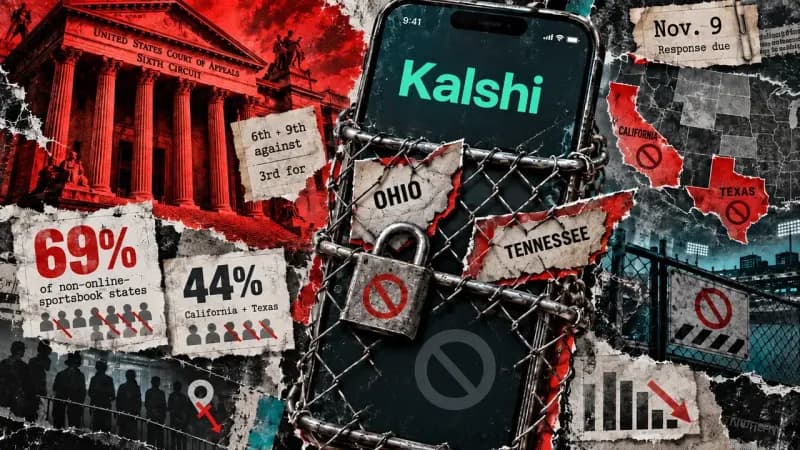
A unanimous panel of the Sixth Circuit Court of Appeals issued its opinion on September 25, finding that Kalshi’s sports contracts do not meet the definition of a swap and that, even if they did, federal commodities law would not override state gambling statutes. The judgment affirmed Ohio’s earlier injunction and lifted a preliminary shield that had protected Kalshi in Tennessee, sending both cases back to the district courts for further proceedings.
Impact on Kalshi’s business model
Kalshi’s platform derives the overwhelming majority of its revenue from sports-related contracts—over 90% of trades and roughly 95% of income in 2025, according to the Ninth Circuit’s earlier findings. Modeling by EKG suggests that about 69% of the company’s retail sports demand originates from jurisdictions without legal online sportsbooks, with California and Texas alone accounting for 44% of that demand. If the company were forced to exclude half of its non-sportsbook footprint, it would lose access to roughly 34.5% of the modeled demand.
Geofencing as a compliance tool
Kalshi argued that its obligations as a designated contract market required uniform access and that segmenting users by geography would be technically arduous and financially burdensome. The appellate judges, however, pointed to existing exchanges that successfully employ geofencing to satisfy both federal exchange rules and state gambling laws, noting that expense alone does not render a solution impossible. In Michigan, a state-court order already requires Kalshi to block sports contracts for users located within the state, with violations punishable by up to $500,000 per day.
Broader industry context
The decision adds to a growing split among federal appellate courts. The Third Circuit backed Kalshi in New Jersey, while the Ninth Circuit rejected the company in Nevada, and the Sixth Circuit now joins the latter with rulings against Kalshi in Ohio and Tennessee. A pending appeal in the Fourth Circuit involving Maryland could further shift the balance. New Jersey has petitioned the Supreme Court to resolve the circuit split, but the Court has not yet granted review.
Industry analysts note that the U.S. sports-prediction market has generated $31.1 billion in execution volume through September 20, 2024, with Polymarket accounting for about 22% of September’s sports-contract volume. In states where online sportsbooks are legal, prediction markets appear to have captured only 2%–4% of the betting handle, indicating that most growth stems from offering services to bettors in jurisdictions where traditional sportsbooks are unavailable. State tax receipts from sports gambling topped $3.2 billion in fiscal 2025, underscoring the financial stakes for regulators.
Next steps and potential appeals
Kalshi must now comply with the Sixth Circuit’s order while it prepares a response to the appellate panel, now due on November 9 after a brief extension. The company may still pursue a favorable ruling on the swap classification, but even a win on that front would not nullify the states’ authority to enforce their gambling laws. The Supreme Court’s pending decision on the New Jersey petition could eventually provide a definitive answer on whether federal regulation can preempt state restrictions.
Why it matters
The ruling clarifies that federal oversight of prediction-market contracts does not automatically shield platforms from state gambling regulations. As Kalshi and peers like FanDuel and DraftKings navigate a patchwork of state rules, the need for sophisticated geolocation and compliance systems will become a critical cost factor. The outcome also signals to investors and policymakers that the U.S. market for sports-related prediction contracts remains fragmented, with regulatory uncertainty likely to shape its growth trajectory for the foreseeable future.


