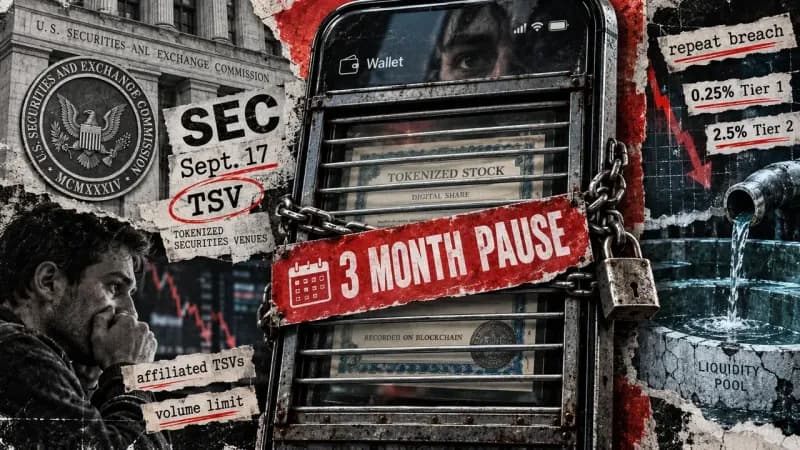
The U.S. Securities and Exchange Commission introduced a five-year pilot on September 17 for Tokenized Securities Venues (TSVs). The program allows a limited set of equities to be issued as blockchain-based tokens and traded through automated market makers (AMMs) rather than traditional order books. Participation is restricted to verified users, and each token must convey the same economic and governance attributes—such as dividends and voting—as the conventional share.
How the volume caps work
The SEC caps the amount of tokenized trading for each listed security by comparing it to the average daily share volume of the same stock in the traditional market during the prior month. Two tiers apply:
- Tier 1 covers S&P 500, Russell 1000 constituents and certain ETFs. An exchange may list up to 75 such securities, and tokenized trading may not exceed 0.25% of the stock’s prior-month average daily volume.
- Tier 2 includes all other eligible securities. Up to 250 can be listed, with a limit of 2.5% of the traditional average daily volume.
The test uses an average-volume metric, meaning a single busy day does not automatically constitute a breach. Instead, the regulator looks at the ongoing daily average across the venue and any affiliated TSVs.
Breach consequences
The first time a stock exceeds its allotted volume, the venue receives a grace period to bring activity back within the limits. Any subsequent breach triggers an immediate three-month suspension of trading for that specific security on the offending venue and all related TSVs. The pause starts on the breach date, while other securities may continue trading normally.
Exchanges may voluntarily suspend trading earlier if they anticipate a breach. They must inform participants promptly and update public notices within five business days.
Investor implications
A token holder’s ability to liquidate depends on the venue’s operational status, not merely on moving the token to a different wallet. During a suspension, the token remains in the investor’s possession, but there is no market to sell it unless an alternative eligible platform exists or a redemption mechanism is provided by the issuer.
Because the tokens are required to retain shareholder rights, holders keep entitlement to dividends and voting, yet they still face liquidity risk. Prospective buyers should ask issuers for clear contingency plans that detail custody, redemption options, and any fees that could apply if trading is halted.
Why it matters
The SEC’s safeguards aim to limit systemic risk while the market tests blockchain-based settlement for equities. However, the volume-based pause mechanism introduces a novel liquidity constraint that could affect investors seeking the convenience of 24-hour trading. Understanding the limits and the potential for a three-month blackout is essential for anyone considering tokenized stocks as an alternative to traditional brokerage accounts.


