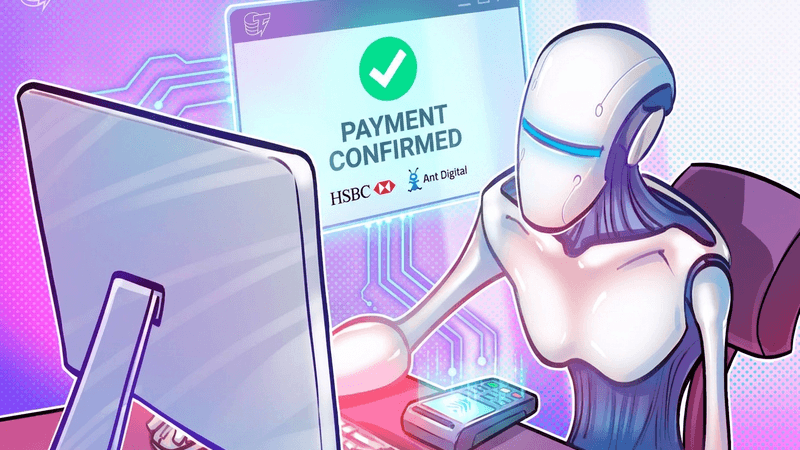
British banking group HSBC partnered with Ant Digital Technologies to run a proof-of-concept where autonomous agents accessed digital services and settled micropayments using tokenised bank deposits on a blockchain test environment.
Test Architecture
The demonstration linked three components: HSBC’s Tokenised Deposit Service, Ant Digital’s Anvita Flow network, and the Jovay Testnet, a layer-2 blockchain sandbox. HSBC supplied the settlement engine and performed instantaneous risk assessments, while Ant Digital’s platform orchestrated service discovery and payment initiation for the AI agents.
Micropayment Execution
During the trial, an AI-driven bot identified a digital offering, invoked the service, and transferred a tokenised deposit of less than two US dollars. The transaction was recorded instantly on the testnet, showcasing the feasibility of sub-$2 payments that could be classified as micropayments.
Broader Banking Experiments
HSBC is not alone in exploring AI-enabled payments. Earlier in the year, Santander completed an AI-agent-initiated transaction using Mastercard’s Agent Pay framework, while Swiss digital-asset bank Sygnum tested similar flows on a public blockchain with customer-approved signatures. Spain’s CaixaBank also ran a card-based AI-agent payment using Visa’s Intelligent Commerce platform. These initiatives illustrate a growing appetite among traditional financial institutions to integrate autonomous agents into existing payment rails.
Infrastructure Challenges
Industry observers note that legacy clearing systems were built for human-initiated actions and may struggle to accommodate continuous, programmatic transactions. Augustus Bank’s chief executive, Ferdinand Dabitz, has argued that purpose-built, stablecoin-centric platforms could eventually supplant parts of the conventional banking stack to better serve AI-driven commerce.
Blockchain’s Role in AI-Driven Finance
Research from Citrini highlighted the potential for autonomous agents to boost demand for programmable financial layers. The firm suggested that because AI agents operate 24/7 across applications, a continuously available infrastructure—such as a blockchain—could become essential for moving money and assets in a machine-readable format.
Limitations and Future Outlook
The HSBC-Ant Digital trial was confined to technical validation and did not involve live customers or a commercial rollout. Nonetheless, the successful settlement of tokenised deposits in real time provides a concrete example of how banks might integrate AI agents with blockchain-based settlement mechanisms in the future.
Why it matters
The experiment signals a shift toward integrating artificial intelligence with distributed ledger technology within the payments ecosystem. If banks can reliably automate micro-transactions using tokenised assets, it could lower friction for a range of digital services, accelerate the adoption of programmable money, and pressure legacy infrastructure providers to evolve. The outcome may influence regulatory discussions, investment strategies, and the competitive landscape between traditional banks and emerging fintech platforms.