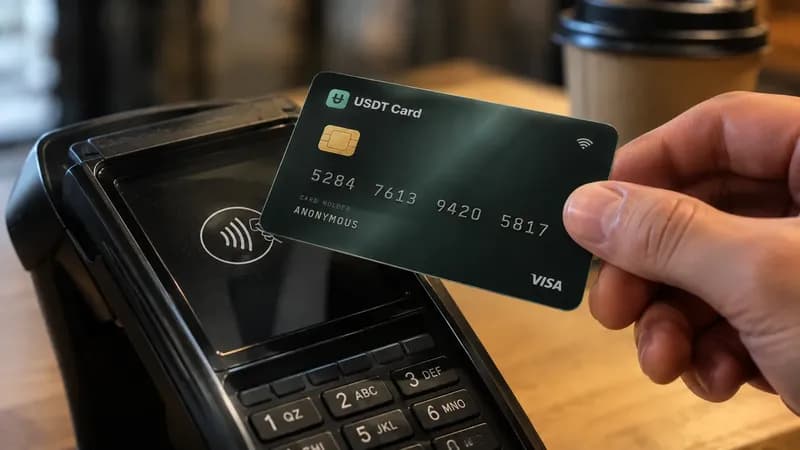
For most people who hold crypto, spending it has meant a detour: sell the coins on an exchange, wait for a bank withdrawal, then pay with a card in their own currency. Prepaid cards funded directly with crypto, and opened without identity checks, cut that detour short. USDT Crypto Card is one service built on that model, and its pitch is aimed less at traders than at people who want to use crypto the way they use a bank card: abroad, and for ordinary bills at home.
Skipping the off-ramp
The usual route from crypto to a purchase has several toll booths. Exchanges charge trading fees or a spread when you sell, banks may charge to receive the transfer, and anyone moving money across borders often pays again on currency exchange. Each step also adds waiting time and, in many countries, an identity check.
A crypto-funded card collapses those steps into one balance. On USDT Crypto Card, users deposit BTC, ETH, SOL, USDT or six other supported assets. Once the network confirms the deposit, it is converted to USDT on Ethereum and credited as a dollar balance. From there, the user issues a virtual Visa or Mastercard and moves part of the balance onto it. The merchant sees a normal card payment and never has to accept crypto itself.
The service says it does not ask for an ID document, selfie, proof of address or phone number. Accounts are accessed with a seed phrase, and a confirmed email is used to secure the account and receive notifications.
What it costs
According to the company's published fee schedule:
- Issuing a virtual card costs $1, with no monthly fee.
- Deposits under $300 carry a 2% fee; deposits of $300 or more carry none.
- Moving money from the account balance onto a card is free, with a $10 minimum.
- Each approved transaction costs $0.30, and declined transactions are free.
There is no separate fee for selling the deposited crypto or for withdrawing it to a bank, because neither step happens. The conversion to USDT is folded into the deposit fee, which drops to zero above $300. Blockchain network fees still apply when sending crypto to the deposit address, and those go to the network, not to the card provider.
A travel card without a currency desk
Travellers are an obvious audience. Rather than buying foreign cash at an airport kiosk or paying a bank's foreign transaction markup, a traveller can load a trip budget in dollars, issue a dedicated card for the trip and add it to Apple Pay or Google Pay to tap at terminals abroad. Because the balance is fixed in USDT, the budget does not swing with the price of bitcoin while the traveller is away.
The company's own travel guide is candid about where this works and where it does not. Flights, prepaid hotel rates, trains, tours and eSIMs bought online are a good fit. Hotel incidental deposits, fuel pumps and car rental security holds are harder: they reserve funds on the card until released, and many rental companies require a credit card in the driver's name at the counter. Payments in a currency other than the dollar are converted by the card network at its own rate, so the final debit can differ slightly from the checkout price.
Rent, groceries and everyday bills
The same mechanics apply at home. A card loaded from a stablecoin balance can pay for groceries at the supermarket by phone, utility and phone bills, streaming subscriptions and online shopping, anywhere Visa or Mastercard is accepted. Users can hold up to 20 cards, so it is practical to keep one for household bills, one for subscriptions and one for shopping, freezing any of them independently.
Rent can work too, where the landlord or property platform accepts card payments, which many now do through online portals. On the standard Virtual plan, cards can spend up to $5,000 per transaction and $20,000 per month, enough for most rents and monthly budgets. A single deposit of $300 or more unlocks the Platinum plan, which removes those limits and allows a physical card for a flat $20 delivery fee.
For people paid in crypto, such as freelancers and remote workers billing international clients, this is the more significant change. Income received in USDT can cover monthly costs directly, without first passing through an exchange and a bank account.
What to keep in mind
Prepaid cards are not credit cards: they spend only what has been loaded, which helps with budgeting but means they cannot cover a hold larger than the balance. Some merchants decline prepaid cards entirely, a limitation of prepaid cards in general rather than crypto cards specifically.
The no-ID model is also a trade-off. Unlike providers that verify customers and name their licences, USDT Crypto Card does not publish a licensing entity, and users rely on the operator to hold their balance. Rules on crypto spending and taxation vary by country, and using a card abroad does not change local law or merchant terms. As with any custodial balance, it makes sense to keep only what is needed for the weeks ahead on the card and to secure the account with two-factor authentication.