Amsterdam’s reputation as a cradle of modern finance dates back to the early 1700s, when satirists mocked speculative bubbles with a series of engravings titled The Great Mirror of Folly. A similar spirit of questioning resurfaced in the 1980s when cryptographer David Chaum arrived in the city to work at the national research institute CWI. Chaum later founded DigiCash, an early attempt at anonymous electronic cash that folded in 1998, a decade before Bitcoin emerged.
The Waterworks of Money – Making Liquidity Visible
At the recent Bitcoin Amsterdam gathering, Dutch artist Carlijn Kingma, together with journalist Thomas Bollen and researcher Martijn Jeroen van der Linden, presented The Waterworks of Money. The piece portrays the financial system as an irrigation network, highlighting zones that are saturated with liquidity and others that remain arid. By rendering the abstract flow of capital into a concrete diagram, the work invites viewers to contemplate how money is generated, allocated and concentrated.
New Voices: ZETRA, RYR and Cypherpunk Now
Three European creators—ZETRA, RYR and Martin Fischer under the moniker Cypherpunk Now—extend the tradition of visualizing monetary systems. All three emerged from the graffiti and hack-together scenes of Germany and the Czech Republic, and each incorporates Bitcoin into their practice.
ZETRA’s Pop-Art Twist
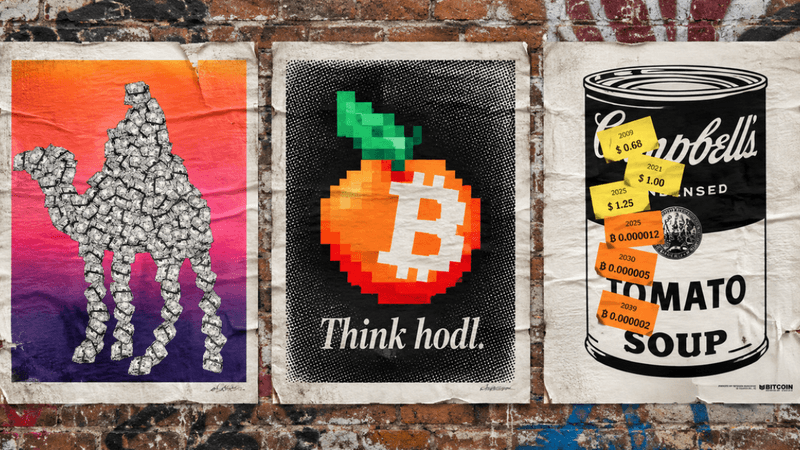
ZETRA, a painter who discovered Bitcoin in 2017, reinterprets Andy Warhol’s iconic soup-can motif in a series called TOMATOSOUP. By affixing real-world price stickers to the cans, the works compare the historical rise of the soup’s price in U.S. dollars with the projected decline when expressed in Bitcoin. The artist says the pieces resonate instantly with crypto-savvy audiences, while others often need a brief explanation.
The BIP39 Series
Drawing on the 2,048-word list that forms Bitcoin wallet recovery phrases, ZETRA’s THE BIP39 SERIES transforms each word into a visual object. Early pieces include a simple list of all words, a yellow smiley face labeled “1638/SMILE”, and a corn-themed print that nods again to Warhol. The ongoing project aims to give physical form to the abstract language that secures self-custody.
RYR’s Deconstruction of Cash
German graffiti artist RYR treats banknotes as raw material. He shreds paper money, burns the remnants to create pigment, and presses the ash into new sheets. The resulting “artifacts from the future”—including concrete grenades packed with shredded cash—are framed as relics of a post-fiat world. RYR explains that destroying currency is not an act of nihilism but a way to repurpose an existing narrative into a fresh story.
Cypherpunk Now’s Historical Record
Martin Fischer, a member of the Prague collective Ztohoven, co-founded the hackerspace Paralelní Polis, which accepted only Bitcoin for its café. Since 2020 he has produced screen-printed works under the name Cypherpunk Now, documenting the evolution of Bitcoin culture from its early days to its present mainstream visibility.
Tension Between Ideals and Institutional Adoption
All three artists acknowledge that Bitcoin’s growing acceptance by banks, investment funds and corporations challenges the movement’s original anti-establishment ethos. RYR’s concrete weapons, imagined as fossils from a fiat-war victory, embody this paradox: the technology designed to sidestep traditional finance is now being absorbed by the very institutions it sought to bypass.
Why it matters
The artworks on display at Bitcoin Amsterdam offer a visual vocabulary for debates that often remain abstract. By converting code, cash and cryptographic seed words into paint, paper and concrete, the creators make tangible the shifting power dynamics between decentralized finance and established financial systems. Their pieces serve both as celebration of Bitcoin’s cultural reach and as critique of its co-option by mainstream actors, prompting viewers to consider where the original promise of self-sovereign money stands today.