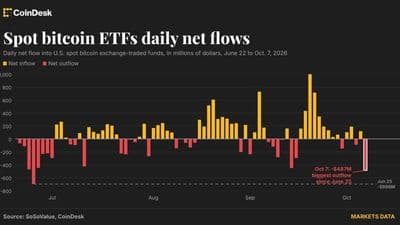
Analysts believe the next major lift in Bitcoin’s price will stem from a reallocation of funds away from gold and from the lofty levels of U.S. equities, channeling fresh capital into the cryptocurrency.
Capital Rotation from Gold
Gold remains roughly 25% beneath its historical high, positioning it as a potential source of liquidity for Bitcoin. When gold prices stabilize or retreat, investors seeking higher returns may look to assets with a stronger upside, and Bitcoin has historically been the beneficiary of such shifts. The current price gap between gold and its all-time peak creates a sizable pool of capital that could be redeployed into digital assets if market sentiment turns.
Equity Market Corrections as a Catalyst
U.S. stock indices have reached unprecedented valuations, prompting concerns about a corrective move. A downturn in these markets would free up risk-on capital, and Bitcoin often emerges as an alternative store of value for investors willing to embrace volatility. The notion is that a pullback in equities could act as a catalyst, prompting traders to diversify into crypto, thereby supporting a new price leg for Bitcoin.
Stablecoin Inflows and Institutional Dynamics
Historical data shows that inflows into stablecoins tend to seep into Bitcoin over time. When stablecoins accumulate, they provide a reservoir of readily deployable capital that can be swapped for Bitcoin with minimal friction. In addition, institutional activity—such as bond repurchase programs led by prominent investors—has previously coincided with simultaneous rallies in both gold and Bitcoin. This suggests that large-scale financial maneuvers can indirectly boost demand for the cryptocurrency.
Investor Horizon and Market Structure
Recent research indicates that Bitcoin holders are extending their holding periods, hinting at a shift toward longer-term positioning. Longer horizons can dampen price swings, potentially making future rallies less abrupt. Moreover, the market’s volatility profile may adjust as options activity and institutional participation evolve, leading to a compression of price cycles.
Outlook and Risks
While the capital rotation narrative is compelling, several risk factors remain. Ongoing rate hikes, rising 10-year Treasury yields, and broader concerns about the fiat monetary system could influence investor behavior. European monetary stress, exemplified by French bond market pressures, adds a geopolitical layer to the risk calculus. Additionally, challenges surrounding tokenization, altcoin competition, and the need for continuous liquidity could affect Bitcoin’s price trajectory.
Why it matters
Understanding where the next wave of money may flow helps market participants gauge Bitcoin’s potential upside and the timing of entry points. If gold and equities indeed relinquish capital, Bitcoin could experience a sustained rally, reshaping its role as a digital store of value and influencing broader financial market dynamics.