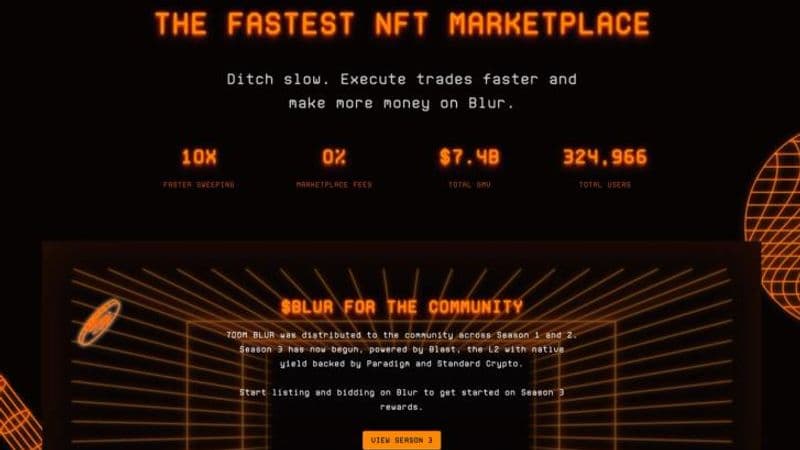
Blur, once the leading Ethereum NFT exchange, announced that its public marketplace will cease operations on Nov. 12. The decision follows a dramatic collapse in trading activity and comes shortly after the shutdown of Blast, another project founded by the same entrepreneur.
Closure timeline and remaining services
The company confirmed that the website will be taken offline on Nov. 12, and its NFT-backed lending platform, Blend, will no longer originate fresh loans after that date. Existing borrowers must either repay their obligations or allow defaults before the deadline. Blur said it will later provide a separate utility for users to retrieve assets tied to Blend. While the front-end is closing, the underlying Ethereum smart contracts will stay functional, and BLUR token holders will retain the ability to vote on the fee-switch mechanism that could enable future trading fees.
Trading volume collapse
Data from DefiLlama shows that Blur’s monthly transaction volume peaked at roughly $1.43 billion in March 2023, representing more than 70% of all Ethereum NFT trades at the time. By March 2026, that figure had shrunk to under $7 million, a decline of more than 99.5%. The platform’s zero-fee model attracted professional traders with fast execution and token rewards, but the volume drop indicates that the incentive-driven traffic did not sustain long-term demand.
Financial performance and token impact
Despite handling billions of dollars in NFT sales, Token Terminal records zero protocol revenue for Blur over the past three years, as the marketplace never charged transaction fees. The lack of fee income makes it unclear whether any profit was derived from Blend or ancillary services. Following the shutdown announcement, the BLUR token fell more than 20%, trading around $0.015.
Background and related project shutdowns
Blur launched in 2022 under the direction of crypto entrepreneur Tieshun Roquerre, also known as Pacman. It quickly overtook OpenSea by offering lower latency and reward schemes, propelling it to market dominance in early 2023. However, its aggressive incentive structure drew criticism for encouraging speculative flipping and pressuring creator royalties.
Earlier in October, Roquerre’s scaling network Blast announced its own closure. Blast had once amassed over $2 billion in assets, largely through reward incentives, but assets dwindled to about $32 million before developers cited operating costs that exceeded revenue. The Blast shutdown set a precedent that Blur now follows.
Why it matters
Blur’s exit highlights the fragility of fee-free, incentive-heavy NFT platforms, especially when they rely on token rewards rather than sustainable revenue streams. The shutdown leaves a gap in the Ethereum NFT ecosystem, potentially reshaping market share among remaining exchanges and prompting creators to reconsider where to list their work. Moreover, the continued operation of Blur’s smart contracts means that existing trades and loans remain on-chain, requiring users to manage withdrawals and repayments without the support of an active marketplace.