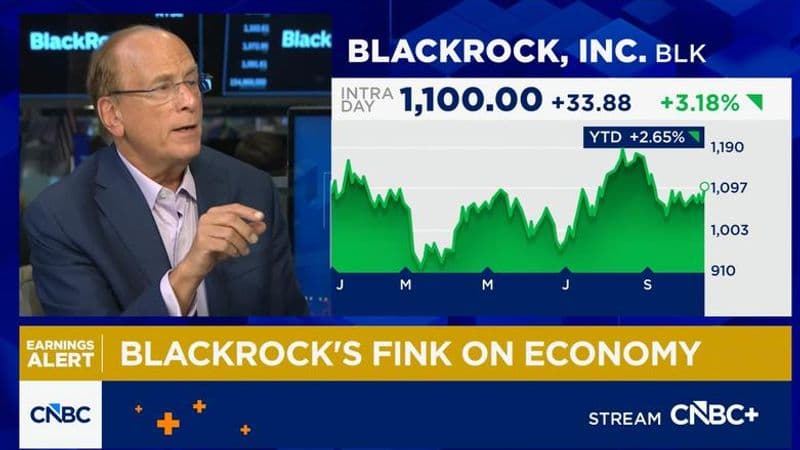
BlackRock chief executive Larry Fink warned that imposing a moratorium on data-center construction in the United States could tip the economy into a recession, while also drawing attention to the nation’s $40 trillion debt burden.
Data-center investment underpins AI expansion
The United States is on track to invest roughly $700 billion in data-center infrastructure this year, according to Moody’s, with cumulative spending expected to reach between $2.4 trillion and $2.48 trillion by 2030. Global outlays could hit $7 trillion by decade’s end. These facilities house the massive computing power needed for artificial-intelligence workloads, and the construction pipeline supports jobs in building, energy supply and hardware manufacturing.
Fink’s recession scenario
During a CNBC interview, Fink argued that a policy move to curb data-center development—driven by environmental concerns—would constitute a “moratorium of some sort” capable of delivering two consecutive quarters of shrinking output, the textbook definition of a recession. He dismissed prevailing public anxiety, noting that a Pew Research Center poll found nearly half of Americans view data centers as detrimental to the environment, energy costs and nearby quality of life. Fink labeled much of that sentiment as misinformation and emphasized the sector’s contribution to employment and economic growth.
Growing fiscal pressures
Fink also highlighted the escalating cost of servicing the federal budget. The national debt has risen from $8 trillion in 2000 to $40 trillion in 2026, a $32 trillion increase that he said is “having a serious impact” on credit demand. Larger bond auctions and higher borrowing needs, he warned, could strain the financial system, prompting a call for private-capital solutions to sustain a 3% growth rate.
Ripple effects on crypto assets
A broader economic slowdown typically dampens appetite for higher-risk investments, a dynamic that could extend to digital assets. Although Bitcoin is sometimes touted as a safe haven, historical data shows it can suffer selling pressure when investors flee riskier positions. At the time of reporting, Bitcoin was trading near $81,200, down 0.8% since midnight UTC. BlackRock’s iShares Bitcoin Trust (IBIT) remains the largest listed Bitcoin fund, having accumulated $65.62 billion in net inflows since its launch in January 2024.
BlackRock’s financial health
Despite macroheadwinds, BlackRock posted solid third-quarter results, reporting $205 billion in net inflows and a 19% rise in revenue. Adjusted earnings per share climbed 38% year-over-year, and the operating margin reached 47.8%.
Why it matters
The warning from the world’s biggest asset manager underscores how intertwined data-center expansion, AI development, and fiscal policy have become with overall economic stability. A slowdown in the sector could reverberate through credit markets, affect bond yields, and influence investor behavior across traditional and digital assets. For crypto participants, the message is clear: macroeconomic shifts—whether driven by policy, debt levels, or infrastructure decisions—remain a critical factor in market dynamics.