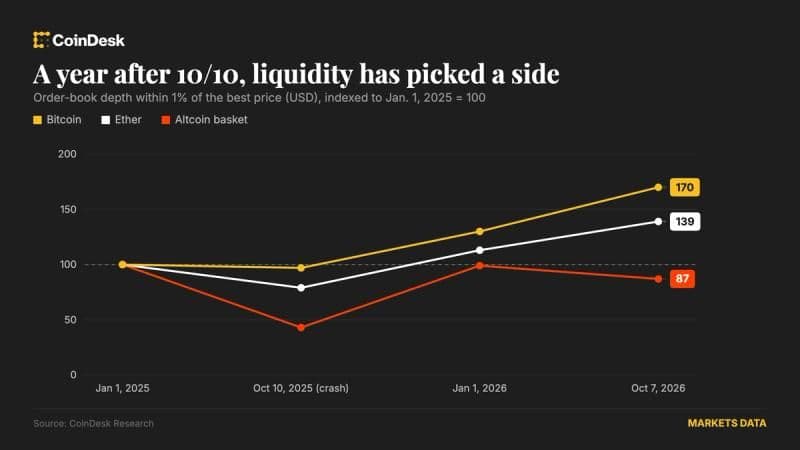
Data from major centralized exchanges indicate that the order books for Bitcoin and Ether have become considerably deeper than they were on the day of the October 2025 crash and at the start of both 2025 and 2026. For Bitcoin, roughly $11.7 million of buy and sell orders sit within one percent of the current price, about 75% higher than a year earlier. Ether shows a similar trend, with liquidity within half a percent of price more than doubling since the crash and the one-percent band rising by roughly three-quarters.
The increase is measured in dollars, not just token units, meaning that market makers have committed additional capital rather than simply benefiting from lower coin values. Near-price bands, where market makers are most active, account for most of the improvement, while deeper bands remain near earlier levels.
Altcoin depth continues to erode
In contrast, a basket of smaller tokens displays a consistent decline in dollar-denominated depth. Since early 2025, the amount of capital within five percent of price has dropped by about a third, and the one-percent band is down roughly one-sixth. When expressed in token units the picture appears less stark, because falling prices have masked the underlying loss of committed capital.
Analysts note that, beyond a handful of exceptions, the trend suggests that market makers are concentrating on the larger assets, leaving most altcoins with thinner order books.
Spot-trading volume remains subdued
Weekly spot-trading volume on centralized platforms has not returned to crash-era levels. Over the four weeks ending September 27, average volume was about $279 billion, roughly two-thirds lower than the $801 billion recorded during the crash week. Volume bottomed out in August at around $135 billion but has since roughly doubled, still falling short of the activity seen during the market’s peak.
Why it matters
The divergent liquidity paths highlight a market that is re-centralizing around Bitcoin and Ether. Institutional participants and market makers appear to favor the two largest assets, reinforcing their dominance and potentially limiting price discovery for smaller tokens. Continued thinness in altcoin order books could increase price volatility for those assets and affect the broader ecosystem’s ability to attract capital.