ARK Invest and Securitize announced that qualified investors can now hold blockchain-based interests in the ARK Venture Fund (ARKVX) on the Ethereum network. The move places a traditional interval fund onto a public ledger, but it does not resolve the fund’s historic liquidity constraints.
Tokenized fund on Ethereum – how it works
The partnership assigns Securitize the role of issuing the digital tokens and managing the on-chain investor experience. Each token corresponds to a proportional claim on the underlying portfolio of private and public technology companies managed by ARKVX. Holders therefore possess a digital representation of the same economic exposure as conventional shareholders, but the ownership record resides on Ethereum.
Liquidity constraints and repurchase mechanism
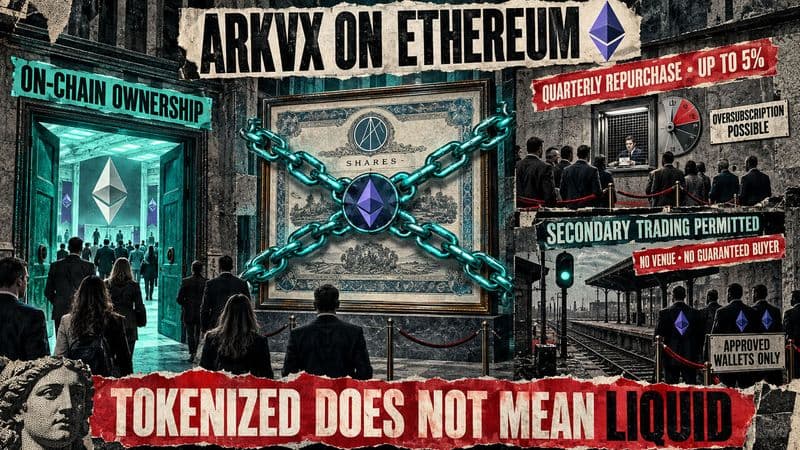
Despite the blockchain veneer, the fund’s exit options remain narrow. ARK’s 2026 calendar designates September 30 as the upcoming repurchase deadline, just days after the token launch. The fund’s policy permits it to buy back at most five percent of its total outstanding shares each quarter, using net asset value as the price reference. The announcement does not clarify whether purchasers of tokenized interests after September 24 can participate in the imminent buyback round.
Investors may rely on the quarterly repurchase program or seek a future private secondary transaction, yet no exchange or guaranteed buyer has been identified. The fund’s documentation stresses that the shares are unlisted and that a secondary market should not be expected, reinforcing the characterization of the tokens as illiquid.
Regulatory backdrop and future trading possibilities
A recent SEC order grants ARK permission to offer a tokenized share class that could, in theory, be traded on alternative trading systems or quoted on other platforms. The order, however, imposes strict controls: only approved wallets may hold the tokens, and ARK does not anticipate a vibrant trading environment at launch. Potential avenues such as over-the-counter, peer-to-peer, or alternative-system transactions are mentioned, but they remain subject to the same wallet restrictions.
The SEC filing also notes that repurchase offers are allocated across the entire fund, meaning the tokenized class does not receive a dedicated buyback pool. Consequently, any future market activity would still be constrained by the same limited redemption capacity.
Tokenization in the broader market context
Real-world asset tokenization is approaching a $30 billion valuation, yet decentralized finance captures only a modest share of that total. ARK’s initiative illustrates how established financial products are experimenting with blockchain infrastructure, but the liquidity limitations underscore the gap between token issuance and functional tradability.
Why it matters
The ARK-Securitize collaboration marks one of the first attempts to place a sizable interval fund on a public blockchain, signaling growing institutional interest in tokenized securities. At the same time, the continued reliance on quarterly buybacks and the absence of a secondary market highlight the practical hurdles that must be overcome before tokenized assets can deliver the liquidity benefits often touted by proponents. How quickly a robust trading ecosystem emerges—and whether regulatory allowances translate into real buyer interest—will shape the trajectory of future tokenized fund offerings.