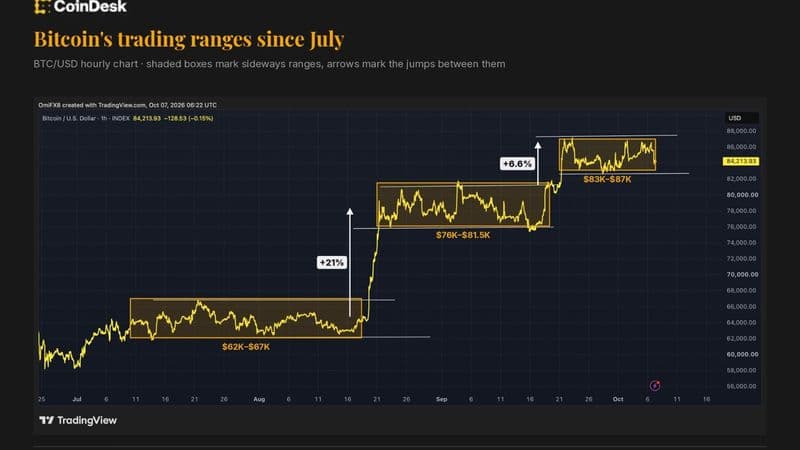
Bitcoin traded around $84,300 on Wednesday, slipping to roughly $84,200 after a 2% drop from the previous day's high near $86,500. Despite the decline, the cryptocurrency remained inside the $83,000-$87,000 corridor that has defined its recent market behavior.
Step-wise pattern overview
Since July, Bitcoin has risen through a series of horizontal zones that gradually shift upward, creating a visual resembling a staircase. The first segment, from mid-July to mid-August, saw the coin bounce between $62,000 and $67,000 before a rapid 21% surge over three days. The next plateau stretched from late August to mid-September, ranging from $76,000 to $81,500, followed by a 6.6% jump in late September. The current step began after the September breakout, anchoring the price between about $83,000 and $87,000.
Support levels and potential scenarios
Analysts highlight the $83,000 mark as the critical floor. If Bitcoin can sustain trading above this threshold, it would suggest that bearish pressure is insufficient to force the market back into earlier ranges. Conversely, a clear breach below $82,000 would indicate that the September breakout failed, potentially re-exposing the $80,000-$81,500 zone as the next area of interest.
Analyst commentary
Vikram Subburaj, chief executive of an Indian exchange, emphasized that the recent dip does not invalidate the step-wise climb. He noted that maintaining the $83,000 level would demonstrate that sellers cannot drive the price back into its prior band. Market analyst Alex Kuptsikevich pointed to a slightly higher support around $84,000, warning that a drop beneath that point could open the path toward the $80,000 region.
Why it matters
The ability of Bitcoin to hold its current range is pivotal for the broader market narrative. A firm hold above $83,000 would reinforce confidence in the ongoing upward trajectory, potentially encouraging further institutional participation. In contrast, a decisive break below the key support could trigger renewed bearish sentiment, affecting risk appetite across the crypto sector and influencing related assets.