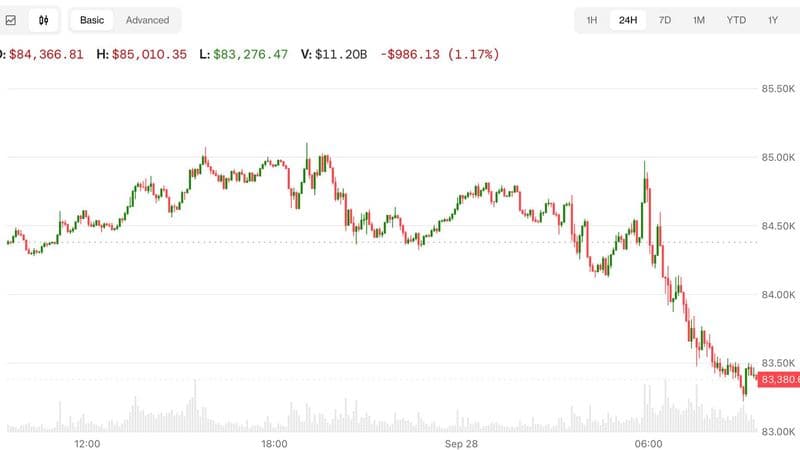
Bitcoin and Nasdaq futures opened the week lower after President Donald Trump suggested that additional U.S. strikes on Iran could occur before the upcoming midterm elections. The prospect of renewed conflict pushed crude oil higher, reinforcing a broader atmosphere of market unease.
Market reaction
At 03:30 UTC, Bitcoin was trading about 1.3% below $84,000, while major altcoins such as Ethereum, XRP and Solana posted comparable declines. The Nasdaq-linked futures index slipped roughly 0.7%, reflecting the ripple effect of geopolitical risk on equity markets. Meanwhile, futures tied to West Texas Intermediate crude climbed nearly 1% to $93.28 a barrel, with Brent showing a similar upward move.
Geopolitical backdrop
President Trump told Fox News that the war with Iran might end “very soon,” yet he did not rule out further strikes, saying, “It’s possible, but I just don’t want to say that.” Iran’s foreign minister countered that Tehran is fully prepared for renewed fighting and even floated a proposal at the United Nations to briefly reopen the Strait of Hormuz. Trump dismissed the suggestion, arguing that Iran seeks a deal only under heavy pressure and emphasizing that Tehran cannot acquire a nuclear weapon.
Technical outlook
Giottus CEO Vikram Subburaj identified the $83,800-$84,000 band as a critical short-term support level for Bitcoin, with resistance positioned between $85,000 and $85,800. He advised traders to avoid chasing the rally at current levels, keep leverage modest, and consider staggered entry points to manage volatility. The cryptocurrency has rebounded strongly in the third quarter, posting a 42% gain over the past three months and outperforming traditional assets such as the Nasdaq and gold.
Upcoming data
U.S. economic releases slated for the week—including the personal consumption expenditures inflation gauge, the Institute for Supply Management manufacturing index, and the non-farm payroll report—could further influence expectations for Federal Reserve policy. Shifts in inflation expectations or employment figures may affect Treasury yields, which have already risen to 5.20% on the 10-year note, the highest level since 2007.
Why it matters
The interplay between geopolitical developments, oil price movements, and upcoming macroeconomic data creates a volatile environment for both cryptocurrency and equity markets. Bitcoin’s price action, tethered to these broader forces, highlights the asset’s sensitivity to external risk factors and underscores the importance of disciplined risk management for investors navigating this uncertain landscape.


